
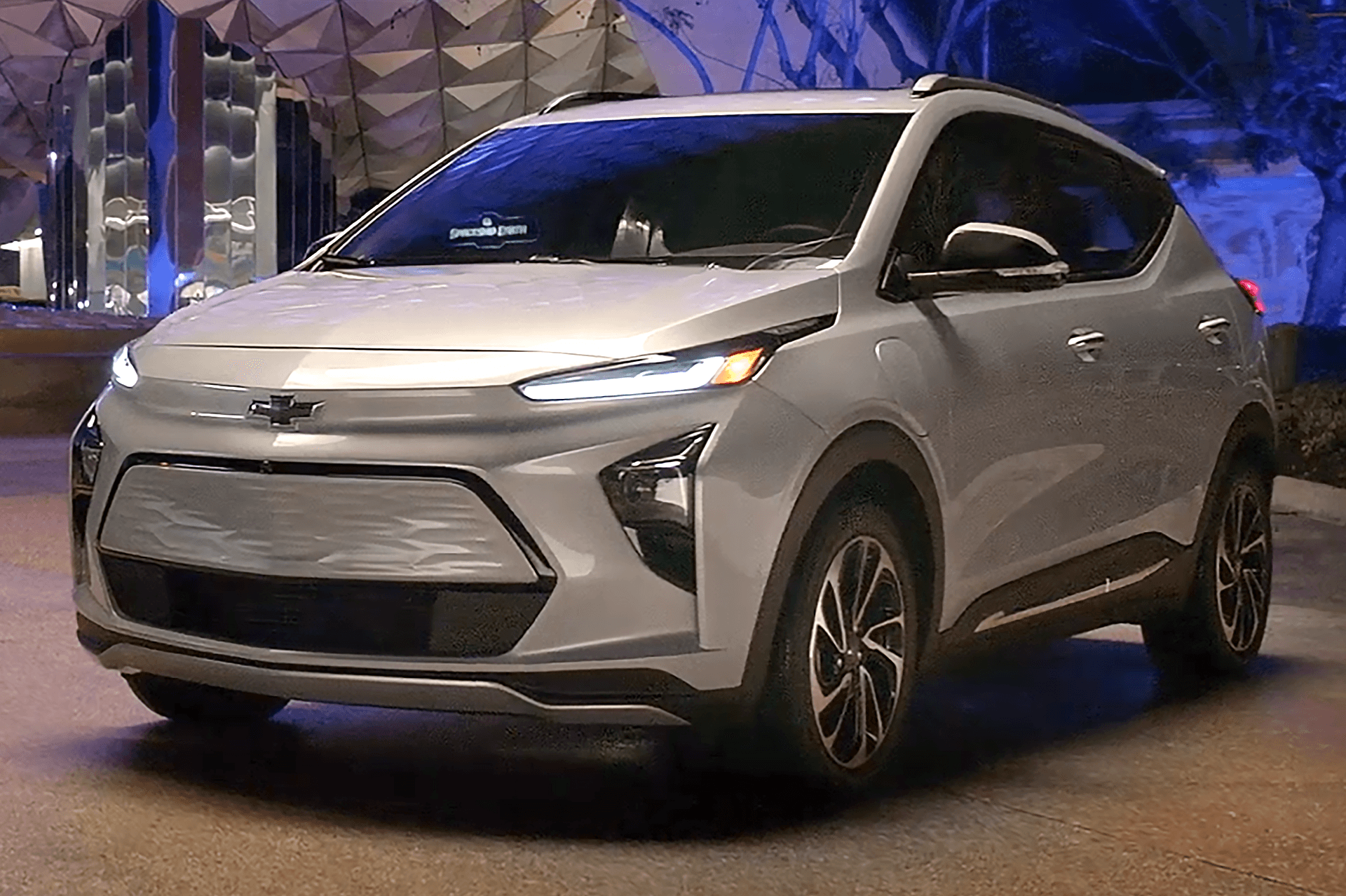
Photo: ChevroletCanada — CC BY 3.0 via Wikimedia Commons. Image credits & removal requests.
Chevrolet Bolt EUV
A slightly bigger Bolt with more rear legroom and available Super Cruise.
Our verdict on the Bolt EUV
The Chevrolet Bolt EUV earns a Decoder Score of 61/100 — a rating computed purely from its specifications, pricing and ownership data, never from advertising relationships. That's a middling result among the 48 electric SUVs we track — it does some things well, but you should go in with clear eyes about the compromises.
A slightly bigger Bolt with more rear legroom and available Super Cruise. At $28,000, the Bolt EUV lands well under the $62,008 average for electric SUVs in our database, and its 247-mile EPA rating ranks 45th of 48 in the segment for range. In one line: this is an EV built for budget, family buyers, and a poor match for road Trip.
Chevrolet offers & financing
As of July 2026We don't have a highlighted national program for the Chevrolet bolt euv right now. Lease and finance offers change often and vary by region — check Chevrolet's site for what's live in your ZIP.
Range
EPA is a lab figure. Here's the realistic band.
How far it really goes
The EPA rates the Bolt EUV at 247 miles of combined range from its 65-kWh battery. Treat that as a lab ceiling, not a promise: across thousands of owner reports, real-world mixed driving typically lands around 82% of the EPA figure, which for this car means roughly 203 miles between charges. That solid result covers a week of typical commuting (the average American drives about 37 miles a day) on a single charge with margin to spare.
Cold weather is the honest asterisk on every EV's window sticker. Batteries lose usable capacity below freezing and cabin heat competes for the same electrons, so plan on roughly 173 miles in a hard winter (about 70% of EPA) — less with a roof box or aggressive highway speeds. Efficiency is the number that quietly matters most for your wallet: at 3.4 mi/kWh, the Bolt EUV sits in the healthy middle of the pack. Run your own numbers with our range calculator, which starts pre-filled for this car.
Charging
Plug types, speeds and what they mean.
Charging: at home and on the road
At home on a Level 2 charger (the Bolt EUV accepts up to 11 kW), a full charge takes about 5.9 hours — an overnight non-event that adds roughly 37 miles of range per hour plugged in. At the national-average residential rate of about $0.17/kWh, filling the battery from empty costs around $11, and every 100 miles costs about $5.00 in electricity — versus roughly $10.63 of gas in an efficient (32 mpg) crossover at $3.40/gallon.
On road trips, the number that matters is not peak kilowatts but how long you stand at the charger. The Bolt EUV peaks at 55 kW on DC fast charging — slow for this class (segment average: 190 kW) — which works out to roughly 75 minutes for the typical 10–80% road-trip stop once real-world charging taper is factored in. Practically, a 600-mile travel day means about 4 charging stops — you leave with a full battery, drive to ~10%, and charge to ~80% each time. Public fast charging costs more (about $0.42/kWh on average), so the same 100 miles runs about $12.35 on the road — the classic EV pattern of cheap weeks and pricier vacations.
Plug politics, decoded: the Bolt EUV uses a CCS port and cannot use Tesla Superchargers as of this writing — you'll rely on CCS networks like Electrify America and EVgo, which are improving but remain less consistent. Factor that honestly into road-trip plans. Estimate a specific trip's charging cost with the charging cost calculator — it uses your ZIP code's actual electricity rates.
Performance
Interior & practicality
Performance and daily driving
Zero to sixty arrives in 6.8 seconds from 200 hp through FWD — relaxed by any standard, and like every EV it delivers that thrust instantly, with no downshift pause. More relevant than the stopwatch: instant torque makes city driving and highway merges feel more responsive than equivalent gas cars, even when outright acceleration is ordinary. One-pedal driving and the low, centered battery mass give the chassis a planted, composed character that surprises most first-time EV drivers.
Space, seats and real utility
The Bolt EUV seats 5 and offers 57 cu ft of cargo space, putting it among the more practical choices in the class. It carries no tow rating, which is common in this class — if towing matters, look at the electric trucks and larger SUVs. A flat floor (no transmission tunnel) frees up more usable cabin space than the footprint suggests, and most EVs add a front trunk for charging cables and small bags.
Battery & warranty
Ownership costs, warranty and incentives
The battery — the component buyers worry about most — is warranted for 8 years / 100,000 miles, the federally required minimum that has proven conservative: real-world degradation data shows most modern packs retaining ~85–90% capacity at 100,000 miles. Bumper-to-bumper coverage runs 4 yr / 50,000 mi. Maintenance is where EVs quietly win: no oil changes, no transmission service, and regenerative braking means pads routinely last past 100,000 miles.
On incentives: the federal EV purchase tax credit ended for vehicles bought after September 30, 2025, so no Bolt EUV purchase qualifies today. State and utility programs still exist and can be worth thousands — check yours with our rebates-by-ZIP lookup. Even with no federal credit, the fuel math favors electric: at 12,000 miles a year, home charging saves roughly $3,375 over five years versus an efficient gas equivalent at today's average prices. Current manufacturer offers — 0% APR programs and bonus cash have become common as EV competition intensifies — often matter more than incentives now.
Known issues worth a pre-purchase check: battery recall history — verify remediation. None of these are unusual in kind — every platform has a list — but walk in informed and verify fixes were applied on the specific car you're buying.
- Affordable
- More rear space than Bolt EV
- Super Cruise available
- Slow DC charging
- FWD only
- Discontinued (parts/used only)
Budget, Family
Road Trip
Real-world ownership notes
What owners and forums flag — verify on any specific car.
How the Bolt EUV compares to its rivals
Nobody cross-shops in a vacuum. Against the electric SUVs closest to it on price and range, the Bolt EUV lines up like this: Volvo EX30 ($6,950 more, 6 mi more EPA range — see the full comparison); Subaru Uncharted ($6,995 more, 61 mi more EPA range — see the full comparison); Toyota bZ4X ($15,070 more, 5 mi more EPA range — see the full comparison). Within the full set of 48 electric SUVs we track, it ranks 45th for EPA range and 1st for lowest starting price. Our comparison tool puts any of them side-by-side across every spec we track, with the Bolt EUV already loaded.
Who should (and shouldn't) buy the Bolt EUV
Buy it if: your priorities look like "budget, family." It fits commuters and families with predictable driving patterns, especially with home charging. The below-average price for the segment means you're getting real value per dollar.
Skip it if: you're road Trip. Frequent long-distance drivers will feel the slow fast-charging on every trip. And if Supercharger access is a hard requirement, this one stays off the list until an adapter path opens. Not sure where you land? Our Find My EV tool matches you to the right EV in six questions — and explains every recommendation.
What will it cost to charge?
Pre-filled for this EV — edit anything.
$0.16/kWh · Enter your ZIP for a local rate
- · 3.4 mi/kWh efficiency
- · $0.16/kWh electricity
- · 10% charging loss
- · 1,000 miles/month
- · Charging where: Home — Level 2 charger (240V), ~11 kW for this car
What range will you really get?
Pre-filled for this EV.
- · EPA baseline 247 mi
- · 70°F ambient
- · 65 mph, 60% highway
- · climate low, 0% degradation
- · 15% arrival buffer for road-trip planning
Owner reviews
No reviews yet — be the first.
Chevrolet Bolt EUV FAQ
The EPA rates the Chevrolet Bolt EUV at 247 miles. Expect roughly 203 miles in real-world mixed driving, and plan on about 173 miles in freezing winter conditions.
About 5.9 hours for a full charge on a home Level 2 charger. On a DC fast charger it needs roughly 75 minutes to go from 10% to 80%, at a peak rate of 55 kW.
About $11 for a full charge at home at the national-average electricity rate ($0.17/kWh), which works out to about $5.00 per 100 miles — roughly 53% less than fueling an efficient gas car. Public fast charging costs more, around $0.42/kWh.
No. The federal EV purchase tax credit ended for all vehicles purchased after September 30, 2025. State and utility incentives may still apply depending on where you live — check your ZIP code on our rebates page.
Not as of this writing. The Chevrolet Bolt EUV charges on CCS networks (Electrify America, EVgo, ChargePoint and others) but does not currently have manufacturer-supported access to Tesla's Supercharger network.
The battery is covered for 8 years or 100,000 miles. Basic vehicle coverage is 4 yr / 50,000 mi.
Tell us what you’re after and one of our trusted advisors will reach out — pricing guidance, lease math, and no dealership pressure.
Next steps
Keep the momentum — every tool is free and pre-filled where possible.
Related guides
The $7,500 federal EV tax credit ended for vehicles acquired after Sept. 30, 2025. What expired, the new loan-interest deduction, and rebates that remain.
Level 1 vs Level 2, what an install costs, and how to charge for pennies overnight.
What battery degradation really looks like, how to read it, and which EVs hold up best.
Similar SUVs


Latest EV intel
From the EV Decoder editorial desk.
Lucid Air, BMW i7, or Mercedes-Benz EQS? We compare range, charging, interiors, and value to find the right six-figure luxury EV flagship for you.
The federal 30C home charger credit, utility rebates worth $250-$1,000, and EV rate plans that keep paying — how to claim every home charging incentive.
Every current Audi EV trim explained: Q4, Q6, A6 e-tron and e-tron GT prices and EPA ranges, the 800V PPE platform, Q8 e-tron's demise, and honest cons.